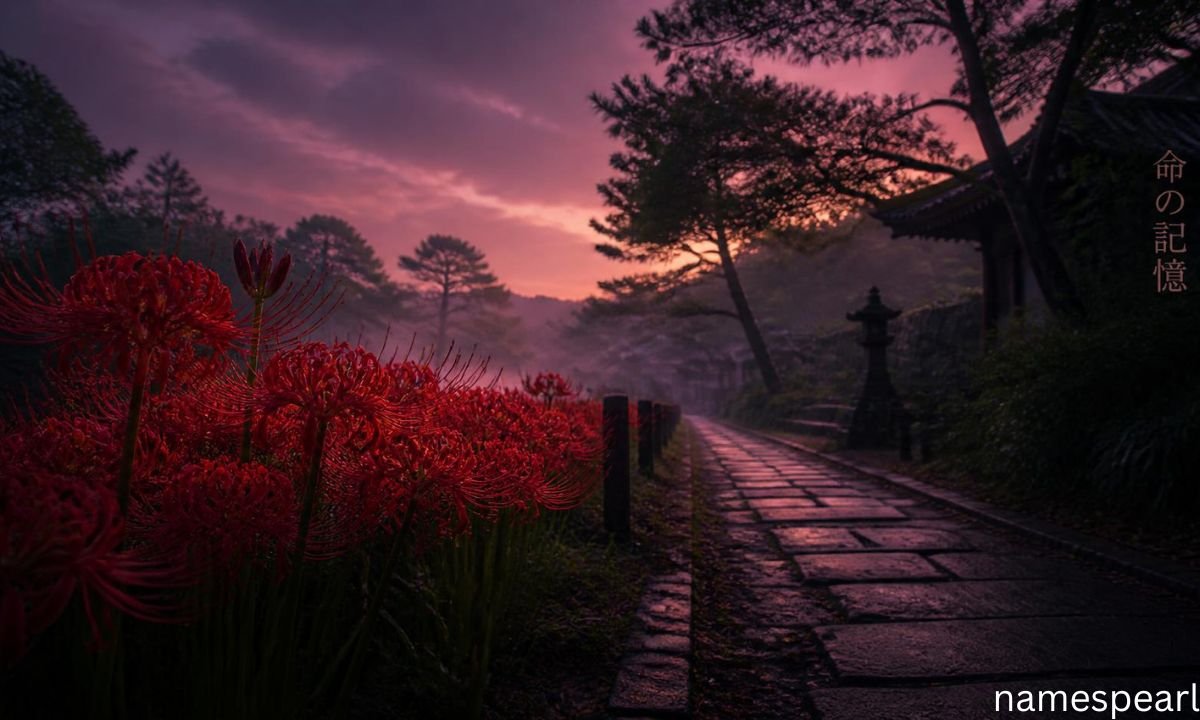

Japanese names associated with death are rarely what people expect. While sorting kanji and readings for this list, one thing stood out: almost none of these names say “death” directly. They hint at it through flowers, fireflies, autumn, and ritual. In plain terms, they’re less about dying and more about memory and change.
That matters because a dark idea in Japanese often arrives in a gentle form. A name like Setsuna (an instant) or Hotaru (firefly) carries grief and memory without sounding grim. Knowing which entries are real given names, and which are only vocabulary, keeps you from borrowing a name that doesn’t exist.
Below you’ll find 310+ entries, each tied to a status: given name, name element, everyday word, folklore figure, or historical name. Every Japanese name associated with death here comes with kanji and a reading, so you can check it yourself. I’ve kept the notes short, so you can scan the full list in one sitting.
Japanese Names Associated With Death: Quick Comparison
This quick comparison shows how Japanese names associated with death fall into five types, so you know what you’re looking at before you read the lists.
| Entry Type | What It Is | Best For | Example |
| Given Name | Used for people | Real naming | Setsuna |
| Name Element | Single kanji part | Name building | 霊 (rei) |
| Vocabulary Word | Everyday term | Language learning | Yomi |
| Folklore Figure | Myth or legend character | Story research | Izanami |
| Cultural Concept | Belief or ritual | Background context | Obon |
Japanese Names Associated With Death to Know in 2026
Here’s the thing: most Japanese names associated with death are gentle symbols, not literal labels. Start with these real given names.
Top Picks
- Setsuna (刹那, setsuna) — Instant; rare given name
- Shion (紫苑, shion) — Aster; remembrance flower
- Hotaru (蛍, hotaru) — Firefly; spirit symbol
- Kiku (菊, kiku) — Chrysanthemum; funeral flower
- Tsubaki (椿, tsubaki) — Camellia; falling-bloom symbol
More Given Names With Quiet Associations
- Sakura (桜, sakura) — cherry blossom
- Ren (蓮, ren) — lotus
- Hasu (蓮, hasu) — lotus, rare as a name
- Sora (空, sora) — sky or emptiness
- Kaede (楓, kaede) — maple
- Momiji (紅葉, momiji) — autumn leaves
- Aki (秋, aki) — autumn
- Shigure (時雨, shigure) — late-autumn drizzle, rare
- Mikage (御影, mikage) — honored shadow or spirit, rare
- Kaguya (輝夜, kaguya) — shining night, legend figure
- Towa (永遠, towa) — eternity
My pick for a real, usable name from this group is Setsuna. It’s short, it’s documented, and the meaning stays literal: a single moment.
How Japanese Kanji Can Change a Name’s Meaning
Japanese names associated with death often depend on kanji, because one reading can match several characters with very different meanings. Fair warning: a reading alone proves nothing, so always ask for the exact characters.
Take “Rei.” Written 零 it means zero, 玲 suggests a clear ringing sound, 礼 means courtesy, and 霊 means spirit. Same sound, four different feelings. That’s why Japanese names associated with death can look darker in romaji than they do in kanji.
Same Reading, Different Kanji
- Rei (零, rei) — zero
- Rei (玲, rei) — clear, ringing jade sound
- Rei (礼, rei) — courtesy
- Ai (哀, ai) — sorrow
- Ai (愛, ai) — love
- Mei (明, mei) — bright
- Mei (命, mei) — life
- Yū (優, yū) — gentle, superior
- Yū (悠, yū) — distant, calm
- Yū (夕, yū) — evening
- Shi (詩, shi) — poem
- Shi (志, shi) — will, aspiration
Kanji That Carry Death Meanings
These are rarely chosen for names, and some may not be approved for registration. Check the current official kanji list before using any of them.
- Shi (死, shi) — death
- Bō (亡, bō) — deceased
- Sei (逝, sei) — pass away
- Sō (葬, sō) — burial
- Chō (弔, chō) — condolence
- Mo (喪, mo) — mourning
- Bo (墓, bo) — grave
- Kotsu (骨, kotsu) — bone
- Shikabane (屍, shikabane) — corpse
Japanese Names Inspired by Mortality and Life’s Transience
Many Japanese names associated with death begin with a quieter idea: life is brief. These words capture that feeling.
Top Picks
- Tsuyu (露, tsuyu) — Dew; fleeting life
- Utakata (泡沫, utakata) — Foam; transient bubble
- Kagerō (蜉蝣, kagerō) — Mayfly; short life
- Hakanai (儚い, hakanai) — Fleeting, fragile word
- Utsusemi (空蝉, utsusemi) — Cicada shell; empty husk
Words About Brief Moments
- Asatsuyu (朝露, asatsuyu) — morning dew
- Hakanasa (儚さ, hakanasa) — fragility
- Isshun (一瞬, isshun) — an instant
- Tsukanoma (束の間, tsukanoma) — a brief moment
- Hitotoki (一時, hitotoki) — a short while
- Ichiya (一夜, ichiya) — one night
- Hitohira (一片, hitohira) — a single petal
- Ichigo Ichie (一期一会, ichigo ichie) — once-in-a-lifetime meeting
Words About a Passing World
- Ukiyo (浮世, ukiyo) — floating world
- Utsushiyo (現し世, utsushiyo) — this world
- Tsuyu no Yo (露の世, tsuyu no yo) — world of dew
- Ukigumo (浮雲, ukigumo) — drifting cloud
- Awa (泡, awa) — bubble
- Mizuawa (水泡, mizuawa) — water bubble
- Yume (夢, yume) — dream
- Maboroshi (幻, maboroshi) — illusion
- Utsutsu (現, utsutsu) — waking reality
- Nagori (名残, nagori) — lingering trace
- Inochi (命, inochi) — life
- Shōji (生死, shōji) — life and death
- Aware (哀れ, aware) — pathos
- Mono no Aware (物の哀れ, mono no aware) — gentle sadness of things
Most of these are words, not given names. Among Japanese names associated with death that people actually use, natural words like Yume are the safer exception.
Names Connected to Yūrei, Spirits, and Japanese Ghost Stories
Japanese names associated with death often borrow from the vocabulary of ghosts and spirits. None of these are common given names; they’re terms.
Top Picks
- Yūrei (幽霊, yūrei) — Ghost; vocabulary word
- Onryō (怨霊, onryō) — Vengeful spirit
- Goryō (御霊, goryō) — Honored, appeased spirit
- Ikiryō (生霊, ikiryō) — Living person’s spirit
- Hitodama (人魂, hitodama) — Floating soul-fire
Spirit Terms (Not Given Names)
- Shiryō (死霊, shiryō) — spirit of the dead
- Reikon (霊魂, reikon) — soul
- Rei (霊, rei) — spirit
- Tamashii (魂, tamashii) — soul
- Mitama (御霊, mitama) — honored spirit
- Seirei (精霊, seirei) — spirit
- Jibakurei (地縛霊, jibakurei) — earthbound spirit
- Funayūrei (船幽霊, funayūrei) — ship ghost
- Ubume (産女, ubume) — woman who died in childbirth, yōkai
- Onibi (鬼火, onibi) — demon fire
- Kitsunebi (狐火, kitsunebi) — fox fire
- Hinotama (火の玉, hinotama) — fireball
- Bōrei (亡霊, bōrei) — departed spirit
- Kodama (木霊, kodama) — tree spirit
Ghost and Spirit Vocabulary
- Obake (お化け, obake) — ghost
- Bakemono (化け物, bakemono) — monster
- Mononoke (物の怪, mononoke) — possessing spirit
- Yōkai (妖怪, yōkai) — supernatural being
- Kaii (怪異, kaii) — strange phenomenon
- Kaidan (怪談, kaidan) — ghost story
- Hyakumonogatari (百物語, hyakumonogatari) — hundred-tale gathering
- Kimodameshi (肝試し, kimodameshi) — test of courage
- Tatari (祟り, tatari) — spirit’s curse
- Noroi (呪い, noroi) — curse
- Ayakashi (あやかし, ayakashi) — uncanny being
Old woodblock prints often show yūrei in white burial kimono. Many sources credit the painter Maruyama Ōkyo with popularizing the legless look. Treat these Japanese names associated with death as vocabulary for stories, not labels for people.
Japanese Names Inspired by Yomi and the World Beyond
Japanese names associated with death often point to Yomi, the land of the dead in early myth. Most entries here are places, not people’s names.
Top Picks
- Yomi (黄泉, yomi) — Land of the dead
- Yomotsu Hirasaka (黄泉比良坂, yomotsu hirasaka) — Slope into Yomi
- Sanzu no Kawa (三途の川, sanzu no kawa) — River of three crossings
- Meifu (冥府, meifu) — Underworld
- Meido (冥土, meido) — Land after death, Buddhist
Places and Worlds (Not Given Names)
- Anoyo (あの世, anoyo) — the other world
- Konoyo (この世, konoyo) — this world
- Tokoyo (常世, tokoyo) — eternal land beyond the sea
- Takamagahara (高天原, takamagahara) — Plain of High Heaven
- Ne-no-kuni (根の国, ne-no-kuni) — land of roots
- Jigoku (地獄, jigoku) — hell
- Gokuraku (極楽, gokuraku) — paradise
- Jōdo (浄土, jōdo) — Pure Land
- Higan (彼岸, higan) — other shore
- Shigan (此岸, shigan) — this shore
- Reikai (霊界, reikai) — spirit world
- Meikai (冥界, meikai) — netherworld
- Muken Jigoku (無間地獄, muken jigoku) — hell of no respite
Afterlife and Rebirth Terms
- Raise (来世, raise) — next life
- Zense (前世, zense) — past life
- Genze (現世, genze) — present world
- Yomigaeri (蘇り, yomigaeri) — revival
- Shide no Yama (死出の山, shide no yama) — mountain of the dead
- Sai no Kawara (賽の河原, sai no kawara) — riverbed of children’s souls, folk Buddhism
- Ōjō (往生, ōjō) — rebirth in the Pure Land
- Yomotsu Hegui (黄泉竈食, yomotsu hegui) — eating the food of Yomi
The Yomi stories land harder once you know them: Izanagi follows his wife Izanami into Yomi, then flees what he sees. That myth is the root of many Japanese names associated with death in later literature.
Names Reflecting the Buddhist Idea of Impermanence
Japanese names associated with death often echo Buddhist teachings on impermanence. These are concepts, titles, and texts rather than given names.
Top Picks
- Mujō (無常, mujō) — Impermanence
- Rinne (輪廻, rinne) — Cycle of rebirth
- Nehan (涅槃, nehan) — Nirvana
- Shogyō Mujō (諸行無常, shogyō mujō) — All things pass
- Satori (悟り, satori) — Awakening
Core Buddhist Terms
- Mu (無, mu) — nothingness
- Muga (無我, muga) — non-self
- Shikisokuzekū (色即是空, shikisokuzekū) — form is emptiness
- En (縁, en) — karmic bond
- Gō (業, gō) — karma
- Inga (因果, inga) — cause and effect
- Bonnō (煩悩, bonnō) — worldly desires
- Mappō (末法, mappō) — age of decline
- Mujōkan (無常観, mujōkan) — sense of impermanence
- Shōrōbyōshi (生老病死, shōrōbyōshi) — birth, aging, illness, death
Figures, Practices, and Texts
- Hotoke (仏, hotoke) — Buddha, or the dead
- Amida (阿弥陀, amida) — Buddha of the Pure Land
- Muryōju (無量寿, muryōju) — immeasurable life
- Kannon (観音, kannon) — bodhisattva of mercy
- Jōbutsu (成仏, jōbutsu) — becoming a Buddha
- Kaimyō (戒名, kaimyō) — posthumous Buddhist name
- Hōmyō (法名, hōmyō) — Buddhist name
- Zen (禅, zen) — meditation school
- Zazen (座禅, zazen) — seated meditation
- Nenbutsu (念仏, nenbutsu) — invocation of Amida
- Shugyō (修行, shugyō) — training
- Hōjōki (方丈記, hōjōki) — medieval essay on impermanence
- Heike Monogatari (平家物語, heike monogatari) — epic opening on impermanence
Kaimyō are given after death by temples, so they aren’t birth names. Japanese names associated with death in this group come from teaching, not from birth registers.
Japanese Words and Name Elements Associated With Darkness
Japanese names associated with death often use darkness as a mood rather than a meaning. Here are the words and kanji behind that feeling.
Top Picks
- Yami (闇, yami) — Darkness
- Kage (影, kage) — Shadow
- Kuro (黒, kuro) — Black
- Ankoku (暗黒, ankoku) — Total darkness
- Shikkoku (漆黒, shikkoku) — Pitch black
Night and Dusk Words
- Kurayami (暗闇, kurayami) — darkness
- Mayonaka (真夜中, mayonaka) — midnight
- Yūyami (夕闇, yūyami) — evening gloom
- Tasogare (黄昏, tasogare) — twilight
- Higure (日暮れ, higure) — sunset
- Yoi (宵, yoi) — early evening
- Yowa (夜半, yowa) — midnight hours
- Shinya (深夜, shinya) — deep night
- Yamiyo (闇夜, yamiyo) — dark night
- Tsukikage (月影, tsukikage) — moonlight and shadow
- Mugetsu (無月, mugetsu) — moonless night
- Tobari (帳, tobari) — curtain of night
Deep, Hidden, and Shadowed
- Shinen (深淵, shinen) — abyss
- Kokuyō (黒曜, kokuyō) — obsidian
- Nubatama (射干玉, nubatama) — poetic word for black
- Yūkoku (幽谷, yūkoku) — deep valley
- Yūgen (幽玄, yūgen) — subtle depth
- Yūmei (幽明, yūmei) — dark and light, living and dead
- Meian (明暗, meian) — light and shade
- Kurai (暗い, kurai) — dark
- Kageboshi (影法師, kageboshi) — silhouette
- Mei (冥, mei) — dim, netherworld
- Yū (幽, yū) — faint, secluded
These Japanese names associated with death work best as mood words, so check any kanji before you commit.
Names Inspired by Autumn, Fading Flowers, and Fleeting Beauty
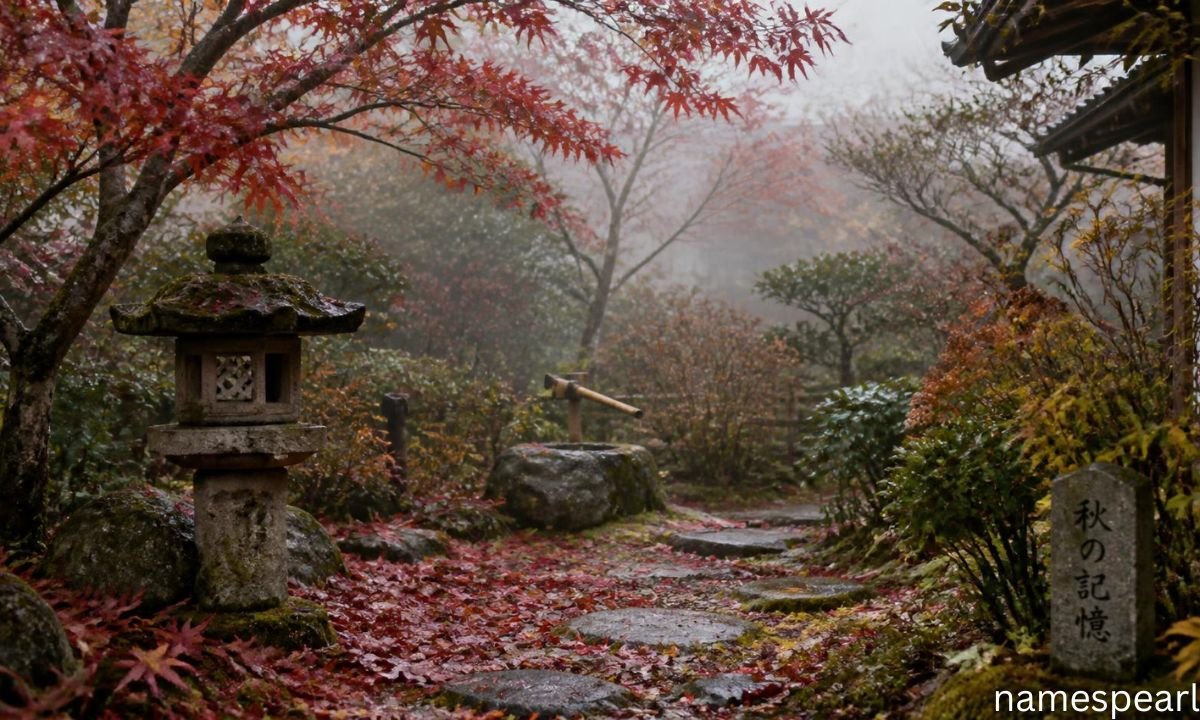
Japanese names associated with death often lean on autumn, when plants fade and the year turns. Nature gives these names their softness.
Top Picks
- Higanbana (彼岸花, higanbana) — Equinox-week flower
- Manjushage (曼珠沙華, manjushage) — Sanskrit-origin flower name
- Ochiba (落葉, ochiba) — Fallen leaves
- Chiru (散る, chiru) — To scatter, fall
- Kareha (枯葉, kareha) — Dead leaf
Autumn Plants and Seasonal Words
- Shibitobana (死人花, shibitobana) — “flower of the dead,” folk name
- Hagi (萩, hagi) — bush clover
- Kikyō (桔梗, kikyō) — bellflower
- Nadeshiko (撫子, nadeshiko) — fringed pink
- Susuki (薄, susuki) — pampas grass
- Ominaeshi (女郎花, ominaeshi) — patrinia
- Fujibakama (藤袴, fujibakama) — thoroughwort
- Kuzu (葛, kuzu) — kudzu
- Aki no Nanakusa (秋の七草, aki no nanakusa) — seven autumn herbs
- Akikaze (秋風, akikaze) — autumn wind
- Kogarashi (木枯らし, kogarashi) — winter-heralding wind
- Meigetsu (名月, meigetsu) — harvest moon
- Tsukimi (月見, tsukimi) — moon viewing
- Shimo (霜, shimo) — frost
- Fuyugare (冬枯れ, fuyugare) — winter withering
Fading Blossoms and Fleeting Beauty
- Sakurafubuki (桜吹雪, sakurafubuki) — cherry blossom storm
- Hanafubuki (花吹雪, hanafubuki) — blizzard of petals
- Hanachirusato (花散里, hanachirusato) — village of falling flowers, Genji character
- Rakka (落花, rakka) — fallen blossoms
- Kareno (枯野, kareno) — withered field
- Kareki (枯木, kareki) — withered tree
- Natsukusa (夏草, natsukusa) — summer grass, Bashō’s famous haiku
- Sabishisa (寂しさ, sabishisa) — loneliness
- Sabi (寂, sabi) — weathered beauty
- Wabi (侘, wabi) — quiet simplicity
- Higurashi (日暮, higurashi) — evening cicada, also a surname
- Semi (蝉, semi) — cicada
- Suzumushi (鈴虫, suzumushi) — bell cricket
- Mushi no Ne (虫の音, mushi no ne) — insect songs
Autumn names stick because the season itself already feels like a farewell, which is why they dominate the Japanese names associated with death that people actually choose.
Japanese Folklore Figures Linked to Death and the Supernatural
Japanese names associated with death include a long list of figures from myth and folklore. They’re characters, not given names, and should stay that way.
Top Picks
- Izanami (伊邪那美, izanami) — Goddess who died, ruled Yomi
- Izanagi (伊邪那岐, izanagi) — Husband who fled Yomi
- Enma (閻魔, enma) — King of hell
- Shinigami (死神, shinigami) — Death god, modern idea
- Jizō (地蔵, jizō) — Guardian of travelers, children
Deities and Guardians of the Dead
- Datsue-ba (奪衣婆, datsue-ba) — old woman at Sanzu River
- Keneō (懸衣翁, keneō) — old man who hangs clothes
- Yomotsu-shikome (黄泉醜女, yomotsu-shikome) — hags of Yomi
- Yomotsu-ōkami (黄泉津大神, yomotsu-ōkami) — Izanami’s title in Yomi
- Kagutsuchi (迦具土, kagutsuchi) — fire god whose birth killed Izanami
- Gozu (牛頭, gozu) — ox-headed guardian of hell
- Mezu (馬頭, mezu) — horse-headed guardian of hell
Demons, Monsters, and Legends
- Oni (鬼, oni) — ogre, demon
- Gaki (餓鬼, gaki) — hungry ghost
- Kijo (鬼女, kijo) — demon woman
- Akuryō (悪霊, akuryō) — evil spirit
- Yuki-onna (雪女, yuki-onna) — snow woman
- Yamauba (山姥, yamauba) — mountain witch
- Onibaba (鬼婆, onibaba) — demon hag
- Ushi-oni (牛鬼, ushi-oni) — ox demon
- Kuchisake-onna (口裂け女, kuchisake-onna) — slit-mouthed woman
- Rokurokubi (ろくろ首, rokurokubi) — long-necked woman
- Nukekubi (抜け首, nukekubi) — detachable head
- Jorōgumo (絡新婦, jorōgumo) — spider woman
- Nure-onna (濡女, nure-onna) — wet woman, water yōkai
- Gashadokuro (がしゃどくろ, gashadokuro) — giant skeleton
- Shuten-dōji (酒呑童子, shuten-dōji) — demon king of Ōeyama
- Ibaraki-dōji (茨木童子, ibaraki-dōji) — demon, Shuten’s companion
- Ōtakemaru (大嶽丸, ōtakemaru) — legendary demon
- Tamamo-no-Mae (玉藻前, tamamo-no-mae) — fox spirit courtesan
- Nue (鵺, nue) — chimera creature
- Hannya (般若, hannya) — jealous demon mask
- Tsukumogami (付喪神, tsukumogami) — aged object spirit
None of these should be mistaken for baby names. They’re characters, and Japanese readers treat them that way. Keep Japanese names associated with death like these for stories, not birth certificates. For a wider, multicultural look at masculine names, see our guide to boy names that mean death.
Japanese Names Associated With Mourning and Remembrance
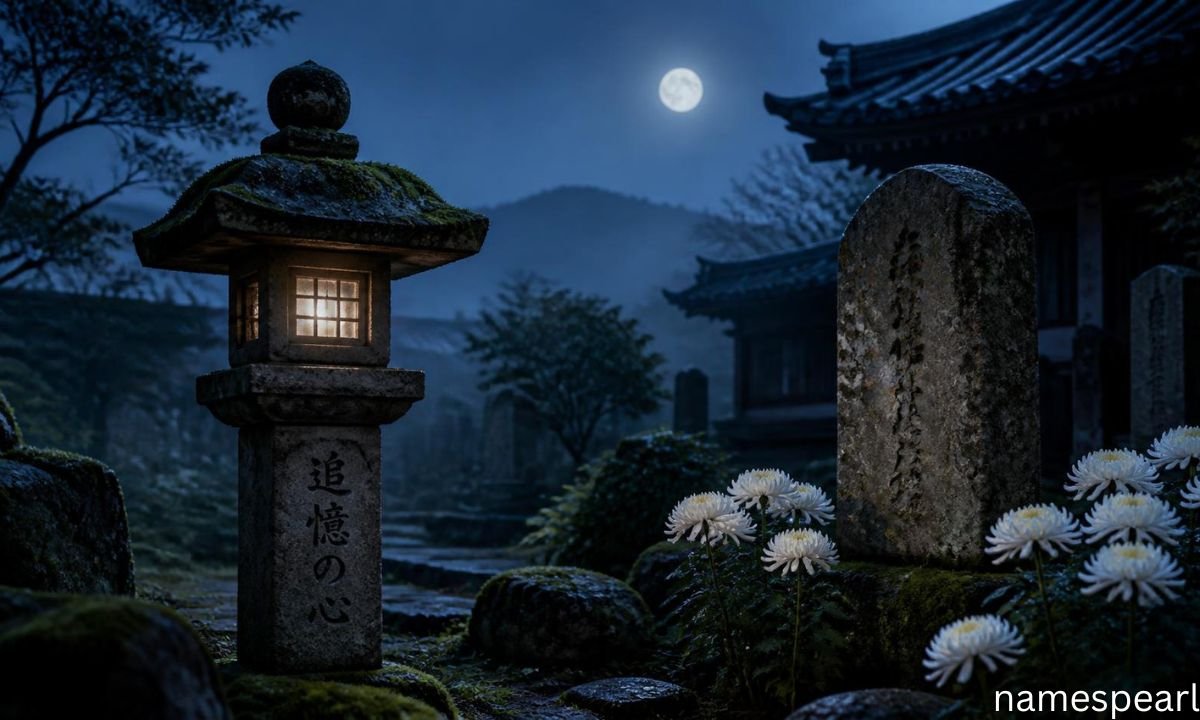
Japanese names associated with death also include words of grief and memory. These show how Japan honors the departed.
Top Picks
- Tsuitō (追悼, tsuitō) — Mourning, memorial
- Tsuioku (追憶, tsuioku) — Remembrance
- Irei (慰霊, irei) — Comforting the dead
- Kuyō (供養, kuyō) — Memorial offering
- Mokutō (黙祷, mokutō) — Silent prayer
Words of Grief and Memory
- Omoide (思い出, omoide) — memory
- Wasuregusa (忘れ草, wasuregusa) — daylily, “grief-forgetting grass”
- Wasurenagusa (勿忘草, wasurenagusa) — forget-me-not
- Shinobu (忍, shinobu) — endure, also a given name
- Itamu (悼む, itamu) — to mourn
- Kanashimi (悲しみ, kanashimi) — sadness
- Nageki (嘆き, nageki) — lament
- Kuyōtō (供養塔, kuyōtō) — memorial tower
- Sotoba (卒塔婆, sotoba) — wooden grave tablet
Rituals and Customs
- Obon (お盆, obon) — festival for ancestral spirits
- Mukaebi (迎え火, mukaebi) — welcoming fire
- Okuribi (送り火, okuribi) — farewell fire
- Tōrō Nagashi (灯籠流し, tōrō nagashi) — floating lanterns
- Shōryō-uma (精霊馬, shōryō-uma) — spirit horse, cucumber figure
- Bon-odori (盆踊り, bon-odori) — Obon dance
- Butsudan (仏壇, butsudan) — household altar
- Ihai (位牌, ihai) — memorial tablet
- Haka-mairi (墓参り, haka-mairi) — grave visit
- Tsuya (通夜, tsuya) — wake
- Sōshiki (葬式, sōshiki) — funeral
- Mogari (殯, mogari) — ancient temporary enshrinement
- Kotsuage (骨上げ, kotsuage) — picking up bones
- Nōkotsu (納骨, nōkotsu) — interment of ashes
- Kōden (香典, kōden) — condolence gift
- Nenki (年忌, nenki) — death anniversary
These aren’t names for people, but they explain why remembrance feels so central in Japanese names associated with death, from Shion to Kiku.
Rare Japanese Names With Somber Cultural Associations
Japanese names associated with death also appear in history, especially among poets and spirits believed to need appeasing. These are historical names, not baby-name suggestions.
Top Picks
- Michizane (道真, michizane) — Deified as Tenjin
- Masakado (将門, masakado) — Rebel; vengeful legend
- Sutoku (崇徳, sutoku) — Emperor; vengeful legend
- Sawara (早良, sawara) — Prince; vengeful spirit tale
- Yamato Takeru (日本武, yamato takeru) — Hero; soul became bird
Poets and Writers on Mortality
- Saigyō (西行, saigyō) — monk-poet
- Bashō (芭蕉, bashō) — haiku master, pen name
- Ryōkan (良寛, ryōkan) — Zen poet
- Ikkyū (一休, ikkyū) — Zen monk-poet
- Issa (一茶, issa) — haiku poet
- Ono no Komachi (小野小町, ono no komachi) — Heian poet
- Izumi Shikibu (和泉式部, izumi shikibu) — Heian poet
- Hitomaro (柿本人麻呂, hitomaro) — Man’yōshū poet, elegies
- Ōtsu (大津, ōtsu) — prince, death poem
- Arima (有間, arima) — prince, executed poet
- Okura (憶良, okura) — poet, wrote of mortality
- Kenkō (兼好, kenkō) — essayist, Tsurezuregusa
- Tsurezuregusa (徒然草, tsurezuregusa) — essays on transience
Related Terms and Rare Names
- Jisei (辞世, jisei) — farewell-to-life poem
- Gaikotsu (骸骨, gaikotsu) — skeleton, Ikkyū collection
- Tenjin (天神, tenjin) — heavenly deity
- Tsukiyo (月夜, tsukiyo) — moonlit night
A short note: these Japanese names associated with death belong to history, so treat them as references.
Japanese Names Inspired by Ghost Stories and Supernatural Legends
Japanese names associated with death show up most vividly in kaidan, the classic ghost stories. These are characters and titles, not given names.
Top Picks
- Oiwa (お岩, oiwa) — Disfigured ghost, Yotsuya
- Okiku (お菊, okiku) — Plate-counting ghost
- Otsuyu (お露, otsuyu) — Lantern-carrying ghost
- Kiyohime (清姫, kiyohime) — Became serpent from love
- Rokujō (六条御息所, rokujō) — Jealous living spirit
Classic Stories and Characters
- Yotsuya Kaidan (四谷怪談, yotsuya kaidan) — Oiwa’s story
- Banchō Sarayashiki (番町皿屋敷, banchō sarayashiki) — Okiku’s story
- Botan Dōrō (牡丹灯籠, botan dōrō) — peony lantern tale
- Dōjōji (道成寺, dōjōji) — Kiyohime temple legend
- Kwaidan (怪談, kwaidan) — Lafcadio Hearn’s collection
- Ugetsu Monogatari (雨月物語, ugetsu monogatari) — tales of moon and rain
- Hōichi (芳一, hōichi) — Earless Hōichi, blind musician
- Yūgao (夕顔, yūgao) — Genji character who dies
- Aoi no Ue (葵上, aoi no ue) — Genji character, possessed
- Bakeneko (化け猫, bakeneko) — ghost cat
Modern Urban Legends and Fiction
- Sadako (貞子, sadako) — fictional ghost, Ring
- Kayako (伽椰子, kayako) — fictional ghost, Ju-On
- Hanako-san (花子さん, hanako-san) — school toilet ghost
- Kokkuri-san (こっくりさん, kokkuri-san) — spirit-summoning game
- Aka Manto (赤マント, aka manto) — red cloak legend
- Teke Teke (テケテケ, teke teke) — half-bodied ghost
- Hachishaku-sama (八尺様, hachishaku-sama) — tall woman legend
- Kunekune (くねくね, kunekune) — writhing figure
- Obake Yashiki (お化け屋敷, obake yashiki) — haunted house
- Hyakki Yagyō (百鬼夜行, hyakki yagyō) — night parade of demons
Fiction names like Sadako exist as real given names too, but the ghost association can follow a person around, which is worth remembering with any Japanese name associated with death.
Japanese Naming Traditions and the Meaning of Kanji
Japanese names associated with death run into Japan’s naming customs, and those customs explain why so few real names sound grim. Parents choose from roughly 3,000 approved kanji, a pool that combines the jōyō and jinmeiyō lists.
Readings are flexible, so the same characters can be read several ways. That’s why the birth registration lists the kanji and the reading separately, and why you should always ask for both.
Sound and stroke count matter too. Many families consult name-fortune methods (seimei handan) that count strokes. Good luck, health, and beauty are the common themes.
Number superstition plays a part. Four (shi) sounds like death, and nine (ku) sounds like suffering, so both are often avoided in gifts and room numbers.
A widely reported 1993 case involved the name 悪魔 (Akuma, “devil”). A Tokyo family court is said to have rejected it as inappropriate. Whatever the exact details, the lesson holds: names with open dark meanings face real resistance.
Common Myths About Japanese Names Associated With Death
Japanese names associated with death are surrounded by myths, mostly from fiction and translation. Here are the five I see most.
Myth 1: Shi (死) is a popular name element. It isn’t. Parents avoid it, and the death-flavored names that do exist lean on flowers and seasons.
Myth 2: Shinigami is an ancient god name. The modern picture owes a lot to later literature, theater, and manga. Classical myth points to Izanami and Enma instead.
Myth 3: Any dark word can be a name. It can’t. Yūrei and Onryō are words, not given names.
Myth 4: Anime names are authentic. Many fictional names use readings no parent would pick, so check them before you borrow one.
Myth 5: One kanji means one thing. As the Rei example showed, the same reading can mean zero, courtesy, or spirit. Real talk: the kanji decides everything.
How to Research a Japanese Name With Dark Symbolism
Researching Japanese names associated with death takes four steps, and each one filters out names that don’t exist.
- Get the exact kanji. Never rely on romaji alone.
- Check the reading. Confirm it in a dictionary such as Jisho.
- Check the status. Is it a given name, a surname, a word, or a character?
- Check the culture. Find a book or museum source for the context.
Quick tip: if you can’t find the kanji for a Japanese name associated with death, don’t use the name.
Example: Higan. Step 1 gives 彼岸. Step 2 gives the reading higan. Step 3 shows it’s a word for the equinox week and “other shore.” Step 4 links it to Buddhist ritual. Verdict: concept, not a given name.
Japanese Names Associated With Death: Meanings at a Glance
This table sums up the main Japanese names associated with death that work as real given names or well-documented terms. It’s a quick check before you decide.
| Name | Kanji | Reading | Meaning | Gender Usage | Status |
| Setsuna | 刹那 | setsuna | Instant | Unisex | Rare given name |
| Shion | 紫苑 | shion | Aster flower | Unisex | Given name |
| Hotaru | 蛍 | hotaru | Firefly | Mostly female | Given name |
| Kiku | 菊 | kiku | Chrysanthemum | Female | Given name |
| Tsubaki | 椿 | tsubaki | Camellia | Mostly female | Given name |
| Ren | 蓮 | ren | Lotus | Unisex | Given name |
| Mujō | 無常 | mujō | Impermanence | Not applicable | Buddhist concept |
| Yūrei | 幽霊 | yūrei | Ghost | Not applicable | Vocabulary word |
| Yomi | 黄泉 | yomi | Land of dead | Not applicable | Mythic place |
| Higanbana | 彼岸花 | higanbana | Red spider lily | Not applicable | Flower word |
Frequently Asked Questions
What are Japanese names associated with death?
Japanese names associated with death are mostly symbols, such as Hotaru and Kiku, not literal “death” names.
Is there a real Japanese given name that means death?
Rarely. Parents avoid 死, so most Japanese names associated with death are words, folklore figures, or fiction.
Can I use Shinigami as a name?
It’s a word for a death god, not a given name. Keep it for characters.
How do I check a reading?
Find the exact kanji, then verify it in a dictionary such as Jisho. Never rely on romaji.
Are Oiwa and Okiku real names?
They’re ghost-story characters. Kiku, the flower name, is a real given name.
Do these names bring bad luck?
Beliefs vary. Parents avoid death kanji but use flower names; Japanese names associated with death rarely sound grim.
Conclusion
The more I dug into these, the clearer this became — Japanese names associated with death are rarely about dying. They’re about memory, seasons, and how short a moment can be. The strongest picks, like Setsuna, Hotaru, and Shion, work because the kanji carry the feeling quietly. A name sticks when there’s real context behind it.
Pick two or three Japanese names associated with death and check their kanji in a dictionary. Decide whether you want a real given name or a symbol for a story. Then say it aloud. When the meaning and the sound match, the name lands without any extra explanation. Use the status labels as your guide.
About the Author
I’m Elena Morgan, writer at Namespearl. I compile name ideas across cultures, with a focus on meaning-based names. This guide to Japanese names associated with death is meant to save you time and keep the facts straight. Pick the names that speak to you, check the kanji, and make your choice your own.
You May Also Like to Explore: Names That Mean Dark Beauty