

Japanese names meaning wind usually begin with one character: 風, read kaze on its own and fuu or kaza inside most names. Other kanji carry the idea too. 嵐 (arashi) joins 山 (mountain) and 風 (wind), 颯 describes a brisk breeze, and 凪 marks the calm when wind stops.
That variety is why sound alone can mislead. Hayate may be written 颯 or 疾風, and Fuuka has at least four common spellings, each with its own second character. Japanese given names are chosen by character as much as by sound, so the kanji decides the meaning.
Below, you’ll find 230+ Japanese names meaning wind, grouped by style: traditional, rare, modern, mythological, and short. Each note stays brief, and entries that are really words, surnames, myths or fictional names are labeled so you don’t mistake them for common given names.
Quick picks: Hayate (颯)、 Fuuka (風花) and Fuuma (風真).
Quick Comparison of Wind Name Types
This table compares the main styles of Japanese names meaning wind, so you can match a style to your taste.
| Name Type | Strategy | Best For | Length |
| Wind-kanji names | Direct 風 meaning | Clear, literal links | 2-4 syllables |
| 颯-based names | Brisk, swift wind | Modern boys’ names | 3-4 syllables |
| Seasonal wind names | Season plus kaze | Poetic, rare picks | 3-5 syllables |
| Mythology names | Wind deities | Story-driven choices | 3-6 syllables |
| Short names | One-beat sounds | Easy pronunciation | 1-2 syllables |
Understanding the Japanese Words and Kanji for Wind
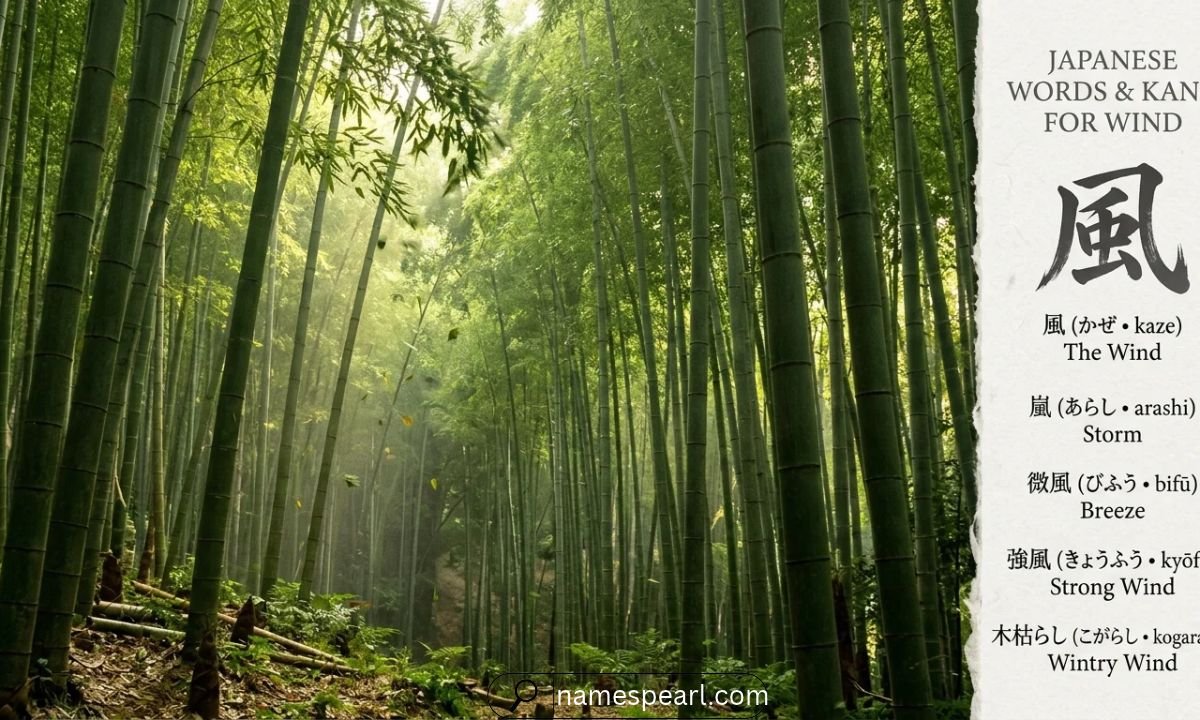
The everyday word is kaze (風). In names it is usually read fuu, as in Fuuta and Fuuka, or kaza-, as in Kazane. One character, two readings, so the kanji tells you more than the sound.
Four other characters come up again and again. 颯 (hayate, sou) describes a quick, brisk wind. 疾風 (hayate, shippuu) is a swift wind or gale. 嵐 (arashi) is a storm, built from 山 and 風. 凪 (nagi) is a calm, made in Japan from a shortened wind component and 止 (stop). Learn these and the lists below get much easier to read.
Names can also be written in hiragana or katakana, which carry no built-in meaning. A name like Kaze written in kana is only a sound, so the wind connection comes from the word it matches. Some words use 風 for manner, not weather: 風雅 (fuuga) means elegance, and 薫 (kaoru) points to scent, so both are loose links at best.
Traditional Japanese Names With Verified Wind Connections
These traditional Japanese names meaning wind come from standard dictionary words, so their wind links are easy to confirm. Kaoru is the loosest link, since it points to scent rather than wind itself.
- Arashi (嵐) — Storm, tempest wind
- Kaoru (薫) — Fragrance, scented breeze (loose wind link)
- Kochi (東風) — East wind, spring
- Kogarashi (木枯らし) — Cold winter gust
- Harukaze — Spring breeze
- Akikaze — Autumn wind
- Kaoruko — Fragrant, breeze-linked
- Fuuga (風雅) — Elegance; no literal wind in the meaning
- Soyo — Rustling gentle breeze
- Fuutarou (風太郎) — Classic wind boy; also the pen name of novelist Yamada Fuutarou
My pick: Kochi, for its soft spring-wind meaning.
Japanese Girl Names Associated With Wind and Breezes
Among Japanese names meaning wind, girls’ names tend to sound soft, often pairing brisk-wind kanji with gentle endings like -ka, -ne, or -mi.
- Souka — Brisk wind, blossom
- Hayane — Swift wind sound
- Hayami — Swift wind beauty
- Haryana — Swift wind grace
- Nagiko — Calm after wind
- Furin — Wind chime
- Suzune — Chime-like bell sound
- Soyoka — Soft gentle breeze
- Kazahana — Wind-blown snow flurry
- Kaori — Fragrance carried on air
- Rinka — Crisp, cool blossom
- Sayaka — Clear, refreshing air
- Misora — Beautiful open sky
- Suzuka — Cool breeze
- Asuka — Flying bird
- Hayuki — Swift wind, snow
Honestly, Furin paints the prettiest picture: a chime moving in summer air.
Japanese Boy Names Linked to Wind and Air
Many Japanese names meaning wind for boys use 颯 (sou), a brisk-wind kanji, with endings like -ta, -ma, or -suke.
- Souta — Brisk wind, great
- Souma — Brisk wind, truth
- Sousuke — Brisk wind, helper
- Souichi — Brisk wind, first
- Souki — Brisk wind, radiance
- Souga — Brisk wind, self
- Souya — Brisk wind, classic ending
- Soushi — Brisk wind, ambition
- Souhei — Brisk wind, peace
- Soutarou — Brisk wind, eldest-son style
- Hayato — Swift wind person
- Hayaki — Swift, bright wind
- Nagito — Calm, windless person
- Rantarou — Storm, great son
- Souji — Brisk wind, second
- Soujirou — Brisk wind, second-son style
- Hayatarou — Swift wind, classic
- Ranto — Storm, modern ending
- Ranki — Storm, brilliance
Souta and Souma sound the most familiar here.
Rare Japanese Names With Wind-Related Readings
Rare Japanese names meaning wind often start as everyday words or surnames, so they read more like poetry than standard given names. Surnames don’t always keep the literal meaning of their kanji, so treat the notes below as spellings only.
- Nowaki — Autumn storm wind
- Tsumuji — Whirl, swirling wind
- Hayachi (疾風) — Old word, sudden gale
- Oroshi (颪) — Wind blowing down a mountain (word)
- Shimakaze — Island wind
- Umikaze — Sea breeze
- Yamakaze — Mountain wind
- Hamakaze — Beach wind
- Minamikaze — South wind
- Kitakaze — North wind
- Nishikaze — West wind
- Natsukaze — Summer breeze
- Fuyukaze — Winter wind
- Kazehaya (風早) — Swift wind, surname-style
- Kazahaya (風早) — Same kanji, alternate reading (surname)
- Kazami (風見) — Weather vane
- Kazama (風間) — Wind interval, surname
- Kazamaki (風巻) — Wind, roll (surname)
- Oikaze — Helpful tailwind
- Kazaguruma — Wind pinwheel
- Karakkaze — Dry winter gusts
- Sakurakaze — Cherry-blossom breeze
- Hanakaze — Flower breeze
- Tsukikaze — Moonlit breeze
- Hoshikaze — Starlit breeze
Heads up: many of these read as words or surnames, so don’t treat them as common given names.
Japanese Names Featuring the Kanji for Wind
Japanese names meaning wind that use the kanji 風 usually read as fuu or kaze, with other characters shaping the meaning.
Boy-Leaning Spellings
- Fuuta (風太) — Wind, thick, big
- Fuuma (風真) — Wind, truth (also 風馬, wind + horse)
- Fuuto (風翔) — Wind, soar (also 風斗, wind + dipper)
- Fuuya — Wind, classic ending
- Fuuki (風輝) — Wind, shine
- Fuusuke — Wind, helper
- Fuuichi — Wind, first son
- Fuujirou — Wind, second son
- Fuukichi — Wind, good fortune
- Fuuhei — Wind, peace
- Fuugo (風吾) — Wind, I, self
- Fuumaru — Wind, round-name style
- Fuugetsu (風月) — Wind and moon, refined enjoyment of nature
- Fuurai — Wind, coming
- Fuurin — Wind, dignified
- Seifuu — Clear, refreshing breeze
- Shifuu — Purple wind
Girl-Leaning Spellings
- Fuuka — Wind plus flower (風花), fragrance (風香), splendor (風華) or song (風歌)
- Fuuko — Wind child
- Fuuna — Wind, grace
- Fuumi — Wind, beauty
- Fuuri — Wind, soft ending
- Fuuha — Wind, feather
- Fine — Wind sound
- Kazane (風音) — Sound of wind
- Fuurika — Wind, floral ending
- Fuuno — Wind, gentle ending
- Fuua (風愛) — Wind, love
Fuuka and Fuuta are the easiest to say, and Fuuka is a good test case: four spellings share one sound and carry four different meanings.
Japanese Names Associated With Air, Movement, and Speed
Japanese names meaning wind also overlap with flight, speed, and open sky, so this group stretches the idea a little. Most of the newer entries here are words, idioms or phrases, and only Jin works as a given name.
Birds, Sky and Flow
- Sorato — Soar through sky
- Sorata — Sky, great
- Kakeru — Soar, dash
- Hibari — Soaring skylark
- Tenma — Sky horse
- Ageha — Swallowtail butterfly
- Ryuu — Flow, current
- Nagare — Stream, flow
- Hayabusa — Falcon, speed
- Maika — Dancing flower
- Washi — Eagle, soaring
- Tako — Wind-flown kite
- Kari — Wild goose
- Kamome — Sea-breeze gull
- Tsubame — Swift swallow
Speed Words, Idioms and Phrases
- Jin (迅) — Swift; the link is speed, not weather (given name)
- Shippuu-jinrai (疾風迅雷) — Swift wind, sudden thunder; extreme speed (idiom)
- Fuurin-kazan (風林火山) — Wind, forest, fire, mountain; Takeda Shingen’s banner, where wind stands for speed (phrase)
- Hayaki koto kaze no gotoshi (疾如風) — “Swift as the wind” (phrase)
- Senpuu (旋風) — Whirlwind, also a sudden craze (word)
- Fuusoku (風速) — Wind speed (word)
- Fuusha (風車) — Windmill (word)
Kakeru sounds like running straight into a breeze.
Names Connected to Fūjin and Japanese Wind Mythology
Fūjin anchors the mythology behind many Japanese names meaning wind, but the wider cast includes Shinto and Buddhist figures too. Treat these as mythology references, not everyday given names.
- Fuujin (風神) — Japanese wind god, shown with a bag of wind and often paired with Raijin
- Fuuten (風天) — Buddhist guardian of the wind, one of the twelve devas
- Shinatsuhiko (志那都比古神) — Wind deity in the Kojiki
- Shinatobe (級長戸辺命) — Wind deity in the Nihon Shoki
- Ame-no-mihashira (天御柱命) — Wind deity enshrined at Tatsuta Taisha, Nara
- Kuni-no-mihashira (国御柱命) — The paired wind deity at Tatsuta
- Susanoo (須佐之男命) — Storm and sea god; wind link is loose
- Tatsuta — Famed wind shrine
- Ryuujin — Dragon god, storms
- Kazamatsuri (風祭) — Wind festival; also a surname
- Fuuraijin — Wind and thunder
Fuujin is the clearest pick; the longer deity names work better as inspiration.
Japanese Names Inspired by Natural Airflow and Changing Winds
These Japanese names meaning wind describe how air behaves: cool, fresh, whirling, or shifting with the seasons. Many are plain words that help you read place names, weather reports and literature.
Breezes and Seasonal Winds
- Suzukaze — Cool breeze
- Kunpuu — Fragrant summer breeze
- Shinpuu — Fresh new breeze
- Shippuu — Swift gale
- Jinpuu — Fast-moving wind
- Aparashi — Green-season wind
- Seiran — Fresh green breeze
- Hatsukaze — First breeze
- Yuukaze — Evening breeze
- Asakaze — Morning breeze
- Asanagi (朝凪) — Morning calm when land and sea breezes switch over
- Shiokaze — Salty sea breeze
- Kawakaze (川風) — River breeze
- Matsukaze — Wind through pines
- Kazeoto — Sound of wind
- Soyokaze — Gentle breeze
- Shunpuu — Spring breeze
- Shuufuu — Autumn wind
Direction, Force and Snow Winds
- Mukaikaze — Facing headwind
- Kazamuki (風向き) — Wind direction
- Kazakami (風上) — Upwind
- Kazashimo (風下) — Downwind
- Junpuu (順風) — Favorable wind
- Gyakufuu (逆風) — Headwind, also adversity
- Tsumujikaze — Spinning whirlwind
- Fubuki — Blowing snow
- Yukikaze — Snow wind
- Hanafubuki — Falling blossom flurry
- Tatsumaki — Tornado, whirlwind
Matsukaze, wind through pines, is a lovely classical image.
Modern Japanese Names With Wind-Related Associations
Modern Japanese names meaning wind lean heavily on 颯, so you’ll see many Sou- names that finish with different meanings. Fiction and history keep wind kanji visible too, so check each label before treating an entry as a given name.
Sou- Names
- Souto — Brisk wind, dipper
- Souna — Brisk wind, grace
- Soumi — Brisk wind, beauty
- Sourai — Brisk wind, arrives
- Soushin — Brisk wind, heart
- Sousei — Brisk wind, star
- Souren — Brisk wind, lotus
- Souri — Brisk wind, village
- Soura — Brisk wind, sky
- Souei — Brisk wind, glory
- Soukai — Brisk wind, sea
- Sourin — Brisk wind, dignified
- Soumei — Brisk wind, bright
- Sougo — Brisk wind, understanding
- Souyuu — Brisk wind, gentle
- Soushun — Brisk wind, talented
- Souryuu — Brisk wind, dragon
- Souen — Brisk wind, garden
- Soukou — Brisk wind, voyage
- Soudai — Brisk wind, grand
- Souten — Brisk wind, heaven
- Soukichi — Brisk wind, fortune
- Soutetsu — Brisk wind, wisdom
- Soune — Brisk wind, sound
- Souha — Brisk wind, feather
- Souichirou (颯一郎) — Brisk wind, first son
Other Modern Spellings
- Satsuki — Brisk-wind moon spelling
- Honami — Sail, waves
- Hotaka — Sail, tall
- Honoka — Sail, flower
- Sakurafubuki — Cherry blossom flurry
- Konoha — Leaf, tree leaves
- Hagoromo — Floating feather robe
Fiction and History
- Kaze no Matasaburou (風の又三郎) — Boy thought to be a wind spirit, in Miyazawa Kenji’s story (fiction)
- Kaze no Tani no Nausicaa (風の谷のナウシカ) — Nausicaä of the Valley of the Wind, Miyazaki Hayao’s manga and film (fiction title)
- Kazama Jin (風間仁) — Wind plus space, a Tekken character (fictional)
- Kazehaya Shouta (風早翔太) — Lead character in Kimi ni Todoke (fictional)
- Fuuma Koutarou (風魔小太郎) — Hereditary name of the Fuuma ninja clan’s leaders, 16th century (historical)
Check the second kanji, since it changes the whole meaning.
Gender-Neutral Japanese Wind Names and Their Usage
Gender in Japanese names comes from the kanji chosen and from local custom. Endings like 太, 真 and 馬 lean toward boys, while 花, 香 and 子 lean toward girls, but these are tendencies, not rules. Gender-neutral Japanese names meaning wind rely on sound and kanji rather than the ending, so the characters do the work.
- Chihaya — Swift, forceful
- Hayase — Swift current
- Shigure — Passing windy shower
- Ryou — Cool, refreshing
- Hibiki — Echo, resonance
- Kanata — Far horizon
- Tsubasa — Wing, flight
- Ibuki — Breath, breeze
- Hayate — Swift gale (疾風) or brisk wind (颯)
- Nagisa — Calm shore
- Nagiha — Calm feather
- Nagiho — Calm sail
- Tatsumi — Southeast, wind trigram
Kaoru (above) and Nagi (below) also suit any gender.
Short Japanese Names With Wind-Related Meanings
Short Japanese names meaning wind are easy to say and often use a single kanji, which keeps the meaning clear.
- Fuu (風) — Wind itself
- Kaze (風) — Plain wind word, rare as a given name
- Sou (颯) — Brisk, dashing wind
- Ran (嵐) — Storm, tempest; on’yomi reading
- Rin — Crisp, dignified
- Nagi (凪) — Calm, lull
- Hane — Feather, wing
- Suzu — Bell, chime
- Sora — Open sky
- Shun — Falcon, swift
- Kou — Sail, voyage
- Shou — Soar, fly
- Taka — Soaring hawk
- Tobi — Black kite
- Kumo — Drifting cloud
- Haru — Spring, warm winds
- Yuu — Leisurely, drifting
- Ho — Sail, catches wind
- Mai — Dance, swirl
- Ten — Heaven, sky
Sou is the easiest one to say: a single long vowel after “s”.
Japanese Words Associated With Breeze, Gusts, and Strong Wind
Some Japanese names meaning wind borrow from weather words, but a few of those words work better as vocabulary than as names. This list also shows how Japanese grades wind by strength. Bifuu (微風) is a faint breeze, kyoufuu (強風) means strong wind, reppuu (烈風) is a fierce wind, and boufuu (暴風) describes a violent storm wind. Toppuu (突風) is a sudden gust, and taifuu (台風) is a typhoon. A few more are handy for reading: kazamidori (風見鶏) is a weathercock, kazetoushi (風通し) is airflow or ventilation, fuuryoku (風力) is wind power, and fuuun (風雲) means wind and clouds, or turbulent times. Then there’s kamikaze (神風), literally divine wind, which carries heavy wartime associations, so it’s a poor name choice. Keep these in your word bank rather than your shortlist.
How Kanji and Name Readings Affect Japanese Name Meanings
Japanese names meaning wind depend on the kanji, not the sound alone. Japanese given names have no fixed reading, so parents choose both the kanji and how to read it.
One Sound, Several Meanings
Fuuka shows the effect: 風花, 風香, 風華 and 風歌 share one sound but mean wind plus flower, fragrance, splendor and song. Hayato shows it from the other side, since 颯人 is brisk wind plus person, while 隼人 puts a falcon in the meaning. Hayate can be 疾風 (swift gale) or 颯 (brisk wind), and 風 itself can be read kaze or fuu.
When the Wind Link Is Loose
Wind kanji also appear where the meaning is loose. 風雅 (fuuga) means elegance and 風流 (fuuryuu) means refined taste, so neither should be sold as a wind name. 凪 is close to wind but names the lull, and 薫 (kaoru) points to scent. Surnames add another layer, because their kanji often come from place names and the literal reading may not match the history. That’s why you can’t confirm a meaning from sound alone, and why hiragana spellings should be treated as sound-only.
How to Verify a Japanese Name Meaning Wind
Use five checks before you trust any Japanese name meaning wind, on this site or anywhere else.
- Get the exact kanji. A romanized name alone doesn’t tell you the meaning.
- Check the reading. Confirm that the kanji can be read that way, using a reliable dictionary such as Jisho or a print one like the Koujien.
- Read each kanji separately. Look up what each character means, then join them.
- Check the use. Decide whether it is a given name, a word, a surname, a myth or a fictional name.
- Ask a Japanese speaker. Native readers can tell you how a spelling feels today.
Worked example: 風花 reads Fuuka, means wind plus flower, and is also the word kazahana for snow flurries. A speaker can confirm whether the name feels natural to them.
Quick tip: write the kanji and read them side by side so you don’t lose track of either, and don’t rely on a single source for the final call.
Meanings at a Glance: 12 Wind-Linked Picks
This table recaps 12 standout Japanese names meaning wind, with the meaning and best use for each.
| Name | Meaning | Best For |
| Hayate | Swift gale (疾風) or brisk wind (颯) | Boys |
| Arashi | Storm (嵐) | Bold tone |
| Kaoru | Fragrance, loose wind link (薫) | Any gender |
| Nagi | Calm after wind (凪) | Any gender |
| Fuuka | Wind plus flower, fragrance, splendor or song | Girls |
| Souta | Brisk wind plus great (颯太) | Boys |
| Kochi | East wind (東風) | Literary, rare |
| Kogarashi | Cold winter gust (木枯らし) | Poetic |
| Soyo | Rustling gentle breeze | Soft sound |
| Fuujin | Wind god (風神) | Mythology fans |
| Aparashi | Green-season wind (青嵐) | Seasonal |
| Yukikaze | Snow wind (雪風) | Winter lovers |
Frequently Asked Questions
What is the Japanese word for wind?
Kaze (風). In names it is often read fuu.
Which Japanese names mean wind suit boys?
Hayate (颯)、 Souta (颯太) and Fuuma (風真) use wind kanji and are used for boys.
Does Nagi mean wind?
Nagi (凪) means a calm. The kanji combines a wind component with “stop”.
Is Fuujin a given name?
Fuujin is the wind god of Japanese myth, so treat it as mythology rather than an everyday given name.
Can one reading have several meanings?
Yes. Fuuka can be 風花, 風香 or 風華, and each kanji changes the meaning.
How do I check Japanese names meaning wind?
Confirm the kanji, the reading and a dictionary meaning before choosing.
Conclusion
Before you choose from Japanese names meaning wind, check three things: the kanji, the reading and how the name is actually used. One sound such as Fuuka can be written four ways, and each spelling has its own meaning. Confirm the exact characters in a dictionary or with a Japanese speaker, then say the name aloud with your surname to hear whether it fits.
Use words, surnames, myth and fictional names as references only, unless a reliable source lists them as given names, and describe loose links, such as Fuuga for elegance, as loose. Kaze and Fuu are direct, Hayate and Souta are brisk, Nagi is quiet, and the seasonal words read like poetry. Pick two or three favorites, keep the one that clicks, and remember that wind is never still, so choose a name with room to grow.
About the Author
Elena Morgan writes name guides for Namespearl, with a focus on clear meanings, honest caveats, and practical naming tips. Her articles, including this guide to Japanese names meaning wind, help readers choose confidently by checking spellings, readings, and cultural context before deciding. She keeps every list simple, readable, and easy to scan.
You May Also Like to Explore: Names That Mean Sky, Names That Mean Sand

1 thought on “230+ Japanese Names Meaning Wind: Rare & Meaningful Picks”